Are Standing Desks Tax Deductible for Your Home Office? The Complete Guide to Deductions & How to Claim Them
Introduction
Many remote workers wonder whether the ergonomic investment in a standing desk can reduce their tax burden. This guide explains the legal framework, eligibility criteria, and practical steps to claim a deduction for a standing desk used in a home office. Readers will also receive curated product recommendations that satisfy both health goals and IRS requirements.
By the end of this article, one will understand the distinction between ordinary business expenses and capital assets, know how to document usage, and be able to select a desk that maximizes tax efficiency while improving workplace comfort.
Background and Context
The United States Internal Revenue Code permits taxpayers to deduct ordinary and necessary expenses incurred in the pursuit of a trade or business. For home‑based professionals, the home‑office deduction is governed by Publication 587, which distinguishes between a simplified square‑foot allowance and actual expense calculations.
A standing desk can be treated as a depreciable asset if its cost exceeds the de minimis threshold (currently $2,500 for most small businesses). Alternatively, a desk that costs less than the threshold may be expensed in the year of purchase under the Section 179 election, provided the taxpayer elects to do so.
Understanding these rules is essential because improper classification can trigger audits or disallowed deductions. The following sections break down the concepts in detail.
Eligibility Criteria for a Home‑Office Standing Desk Deduction
To qualify, the taxpayer must meet two core requirements: the workspace must be used regularly and exclusively for business, and it must be the principal place of business. The IRS interprets "regular" as a consistent pattern of use, not occasional or incidental activity.
When a standing desk is placed in a dedicated office room, the entire desk—including any monitor riser or cable management system—can be allocated to the business portion of the home. The proportion of the desk’s cost that is deductible equals the percentage of the home used for business, calculated as (square footage of office ÷ total home square footage) × 100.
Documentation is critical. Taxpayers should retain receipts, a floor‑plan showing the office dimensions, and a log of daily usage if the desk is shared between personal and professional activities. A clear, written policy can also support the exclusive‑use argument.
How to Claim the Deduction
There are three primary methods to claim a standing desk expense:
- Section 179 Expensing: Elect to expense the full cost in the year of purchase, subject to the $2,500 de minimis limit for home‑office assets. This provides an immediate tax benefit.
- Depreciation: If the cost exceeds the de minimis threshold, claim depreciation over a five‑year recovery period using the Modified Accelerated Cost Recovery System (MACRS). The portion attributable to the home office is calculated using the square‑footage method.
- Simplified Option: Use the $5 per square foot simplified deduction (maximum 300 sq ft). In this case, the desk cost is not listed separately; the flat rate covers all eligible expenses.
Form 8829 (Expenses for Business Use of Your Home) is used for the actual expense method, while Form 4562 (Depreciation and Amortization) handles Section 179 and MACRS depreciation. Tax software typically guides users through these forms.
It is advisable to consult a tax professional to verify eligibility and to ensure the chosen method aligns with overall tax strategy.
Product Recommendations that Add Value
Choosing a standing desk that meets ergonomic standards and satisfies IRS documentation requirements can streamline the deduction process. The following products are highly rated, feature robust construction, and provide clear specifications for tax reporting.
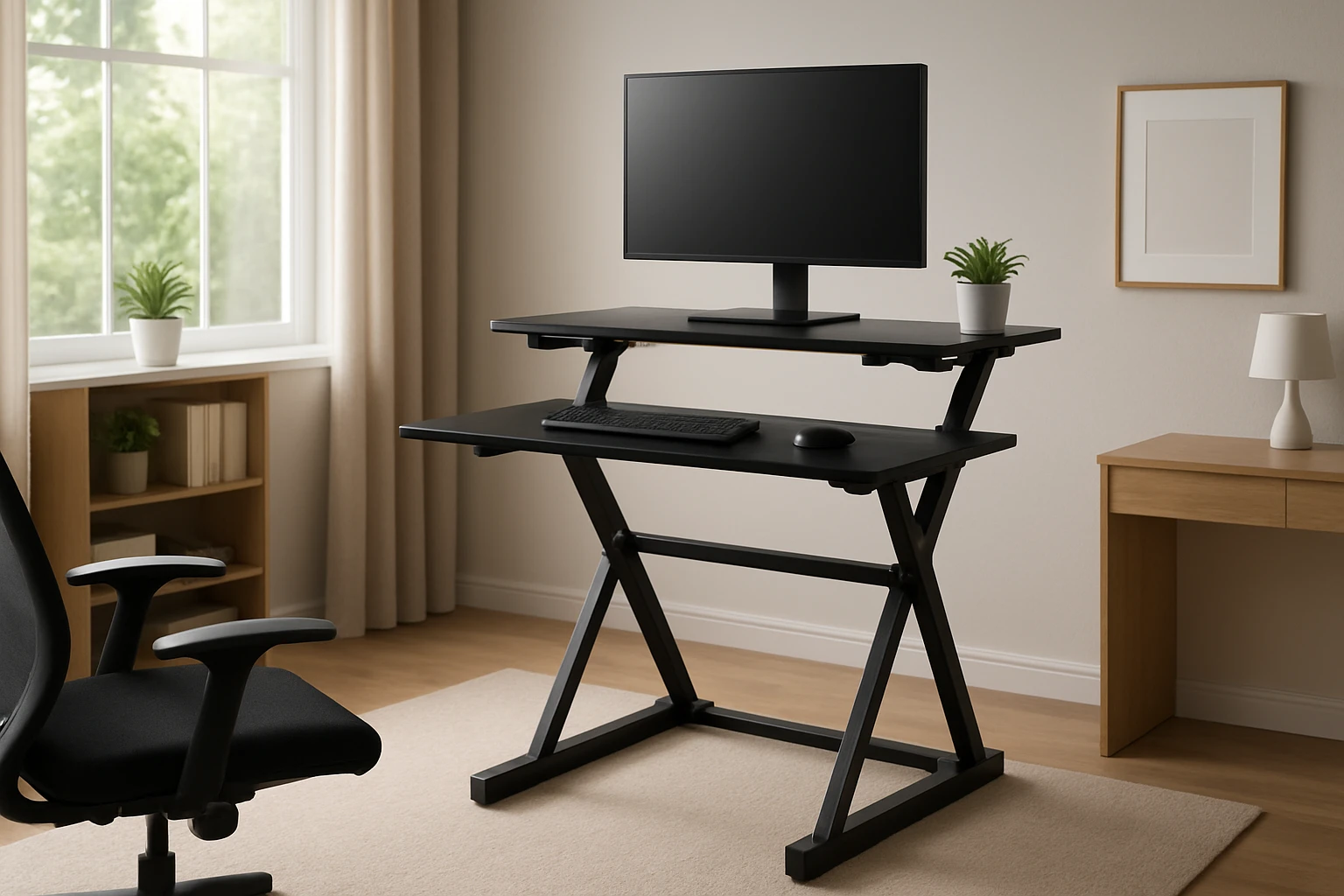
The first product mentioned is FITUEYES Adjustable Standing Desk Converter. This 32‑inch wide converter offers a spacious work surface of 31.5 × 15.7 inches, dual gas‑spring height adjustment from 4.3 inches to 19.8 inches, and a load capacity of 33 lb. Its fully assembled design eliminates setup time, allowing immediate use for tax‑eligible workdays. The product holds a 4.5‑star rating based on numerous positive reviews, indicating reliable performance.
For users who prefer a full‑size electric desk, the Veken Adjustable Standing Desk 47.2'' Brown provides a solid wood surface, memory presets for up to two height settings, and a smooth electric lift ranging from 28.3 inches to 46.5 inches. Priced at $99.99 and rated 4.7 out of 5, it offers excellent value for a home office that requires a larger footprint.
Another compelling option is the Veken Electric Adjustable Standing Desk 47.2''. Though priced at $119.99, it includes additional cable‑management features, a robust wooden desktop, and customer‑validated durability. Users praise its quiet motor and easy assembly, making it suitable for professionals who need a quiet environment for virtual meetings.
Comparison and Selection Guide
When selecting a standing desk for tax purposes, consider the following criteria:
- Cost vs. Depreciation Threshold: Desks under $2,500 can be expensed fully via Section 179; higher‑priced models require depreciation.
- Footprint and Square‑Footage Allocation: A larger desk may increase the percentage of home used for business, affecting the deductible portion.
- Weight Capacity: Ensure the desk can support monitors, laptops, and accessories needed for work.
- Ergonomic Features: Dual‑gas spring or electric height adjustment promotes health and may reduce medical expenses.
The table below summarizes the three featured products against these criteria:
| Product | Price | Height Range | Load Capacity | Rating | Best For |
|---|---|---|---|---|---|
| FITUEYES Adjustable Standing Desk Converter | $— (price not listed) | 4.3"–19.8" | 33 lb | 4.5★ | Compact spaces, dual‑monitor setups |
| Veken Adjustable Standing Desk 47.2'' Brown | $99.99 | 28.3"–46.5" | — | 4.7★ | Budget‑friendly electric lift, wood aesthetic |
| Veken Electric Adjustable Standing Desk 47.2'' | $119.99 | 28.3"–46.5" | — | 4.7★ | Premium build, extra cable management |
For taxpayers seeking an immediate expense deduction, the FITUEYES converter is advantageous because its lower price often falls below the de minimis limit. Professionals requiring a full‑size work surface should consider the Veken electric models, recognizing that the higher cost will be depreciated over five years.
Best Practices & Tips for Maximizing Your Deduction
1. Document Exclusivity: Take photographs of the office layout, label the desk as "business equipment," and keep a written log of daily usage.
2. Maintain Receipts: Store digital copies of the Amazon order confirmation, which includes the product name, price, and seller information.
3. Allocate Properly: Use the square‑footage method to calculate the business portion of the desk cost. For example, a 100 sq ft office in a 1,000 sq ft home yields a 10 % allocation.
4. Consider Section 179 Early: If you anticipate higher income this year, electing Section 179 can lower taxable income more effectively than spreading depreciation.
5. Combine with Health Savings: Some employers offer Health Savings Account (HSA) reimbursements for ergonomic equipment. Coordinating HSA reimbursements with tax deductions can further reduce out‑of‑pocket costs.
Frequently Asked Questions
Q1: Can I deduct a standing desk if I use it for both work and personal activities?
Only the portion of the desk used exclusively for business is deductible. If the desk is shared, calculate the business usage percentage and apply it to the cost.
Q2: Do I need a separate receipt for the desk to claim the deduction?
Yes. The IRS requires a valid receipt showing the purchase date, amount, and vendor. Amazon order confirmations satisfy this requirement.
Q3: What if my home‑office square footage changes during the year?
Adjust the allocation on the tax return to reflect the average square footage used for business throughout the year. Keep a record of the change.
Q4: Is the cable‑management accessory included with the Veken desks deductible?
Accessories that are integral to the desk’s function, such as cable clips, can be bundled with the desk cost and deducted using the same method.
Q5: Can I claim the deduction in the year I purchase the desk if I use the simplified method?
No. The simplified method provides a flat rate per square foot and does not allow separate itemized deductions for furniture.
Q6: How does the de minimis safe‑harbor rule affect my deduction?
If the total cost of all tangible personal property placed in service during the year is $2,500 or less, you may expense the entire amount without filing Form 4562.
Q7: Should I consult a tax professional?
While many taxpayers can handle the deduction themselves, a qualified CPA can ensure compliance, especially when dealing with depreciation schedules and Section 179 elections.
Conclusion
Standing desks can be a legitimate home‑office expense, provided the taxpayer meets the regular‑and‑exclusive use test and follows proper documentation procedures. By understanding the distinction between Section 179 expensing and depreciation, one can choose the most tax‑efficient strategy. Selecting a desk that aligns with both ergonomic needs and cost thresholds—such as the FITUEYES converter or Veken electric models—further simplifies the deduction process.
Implement the best‑practice tips, retain all supporting documents, and consider professional advice to maximize the financial benefit of a healthier workspace.
Products Featured in This Guide
FITUEYES Adjustable Standing Desk Converter
Price: Not listed | Rating: 4.5/5
Featured because it offers a compact, dual‑gas‑spring height‑adjustable platform under the de minimis threshold, making it ideal for immediate Section 179 expensing.
Veken Adjustable Standing Desk 47.2'' Brown
Price: $99.99 | Rating: 4.7/5 (819 reviews)
Featured for its affordable electric lift, memory presets, and elegant wood finish, providing a full‑size workstation that can be depreciated over five years.
Veken Electric Adjustable Standing Desk 47.2''
Price: $119.99 | Rating: 4.7/5 (819 reviews)
Featured because it combines premium build quality, extensive cable‑management, and quiet motor operation, suitable for professionals who need a durable, tax‑deductible office solution.