Introduction
Moving a standing desk into a new apartment can appear daunting, especially when the doorway dimensions are uncertain. This guide will teach the reader how to accurately measure doorway clearance, calculate the required tilt angle, and safely transport the desk using appropriate tools. By following each step, one can avoid costly damage to the desk, the doorway, or the surrounding walls. The information provided is valuable for anyone who wishes to relocate heavy office furniture without professional movers.
What You'll Need
- Steel measuring tape or retractable measuring tape
- Level and carpenter's square
- Protective gloves
- Furniture dolly (recommended: Nest Easy Store Furniture Dolly or MYUEA Heavy Duty Furniture Dolly)
- Safety goggles
- Elastic rope or straps
Step 1: Measure the Doorway Width
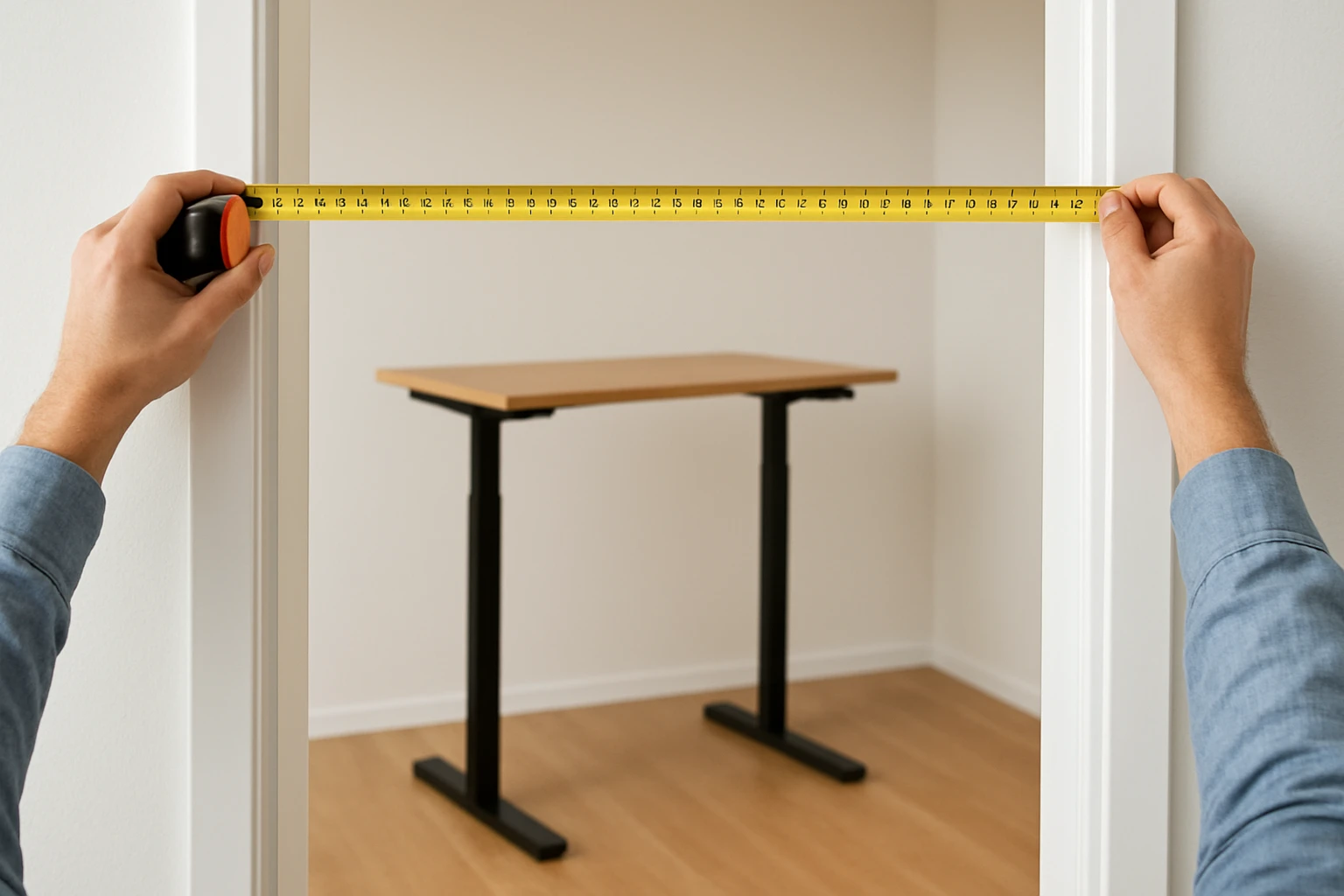
The first action is to determine the clear opening width of the doorway. Use a steel measuring tape to measure from the inner edge of one jamb to the inner edge of the opposite jamb at the narrowest point, typically at the bottom of the frame. Record this measurement in both inches and centimeters for reference. It is essential to note any protruding trim or molding, as these reduce the usable width.
Step 2: Measure the Standing Desk Dimensions
Next, obtain the exact width, depth, and height of the standing desk in its assembled state. Measure the desk width from one side panel to the other, the depth from the front edge to the back, and the height from the floor to the top surface. If the desk can be partially disassembled, measure the largest single component that will need to pass through the doorway. Write down each dimension, because the subsequent calculations depend on accurate numbers.
Step 3: Determine Required Clearance and Tilt Angle
With the doorway width and desk dimensions known, calculate the minimum clearance needed to tilt the desk through the opening. The basic formula for the required width when tilting a rectangular object is: required width = (desk depth × sin θ) + (desk height × cos θ), where θ is the tilt angle. Start with a modest angle of 30 degrees and increase until the required width is less than the measured doorway width. Use a level and carpenter's square to verify the angle while the desk is on the floor.
For example, a desk that is 30 inches deep and 48 inches high will require approximately 36 inches of clearance when tilted at 45 degrees. If the doorway measures 34 inches, a larger tilt angle or partial disassembly will be necessary. This step ensures that the user does not attempt an impossible maneuver that could result in damage.
Step 4: Plan the Path and Remove Obstacles
Before moving the desk, clear the pathway from the loading area to the intended location. Remove rugs, decorative items, and any furniture that could obstruct the route. Check the floor type; both recommended dollies are equipped with silent rubber wheels that protect hardwood, tile, and low‑pile carpet.
Mark the intended path with painter's tape to visualize the movement and to avoid accidental collisions. Ensure that the door can be fully opened without hitting adjacent walls or furniture, as a partially opened door reduces the effective clearance.
Step 5: Disassemble the Desk When Possible
If the standing desk design allows for partial disassembly, remove the tabletop, legs, and any cable management trays. This reduces the overall volume and often eliminates the need for extreme tilting. Keep all screws and small components in a labeled bag to simplify reassembly.
When disassembly is not feasible, use the protective gloves and safety goggles to protect hands and eyes while handling the heavy components. The included pry bar on the Nest Easy Store Furniture Dolly can assist in gently lifting the desk onto the dolly without excessive strain.
Step 6: Position the Furniture Dolly
Place the chosen dolly directly beneath the desk or its largest component. The Nest Easy Store Furniture Dolly features five 360° rotating wheels, a load capacity of 3000 lb, and a built‑in leveler, making it ideal for heavy, bulky items. The MYUEA Heavy Duty Furniture Dolly offers a reinforced carbon steel panel and a fifth wheel for even greater stability, supporting up to 3747 lb.
Secure the desk to the dolly using the elastic rope or straps included in the MYUEA package, or by wrapping the provided rubber anti‑slip mats around the base of the desk. Engage the wheel brakes to prevent movement while positioning the dolly.
Step 7: Execute the Move
With the dolly locked, gently lift one side of the desk using the pry bar and flannel non‑slip mats to raise it onto the dolly platform. Ensure the weight is evenly distributed across the wheels to maintain balance. Slowly release the wheel brakes and begin to roll the dolly toward the doorway, keeping the desk level.
When approaching the doorway, tilt the desk backward while maintaining contact with the dolly wheels. Use the leveler on the Nest Easy Store Dolly or the L‑shaped edge on the MYUEA Dolly to control the tilt angle. Continue to guide the desk through the opening, adjusting the angle as needed based on the calculations from Step 3.
Once the desk is inside the apartment, carefully lower it onto the floor by reversing the lifting process. Re‑engage the wheel brakes, remove the dolly, and set the desk in its final position. Reassemble any removed components, tighten all fasteners, and verify stability before use.
Tips & Pro Tips
- Always measure twice and calculate once; a small measurement error can lead to a failed attempt.
- Apply a thin layer of furniture wax to the dolly wheels for smoother movement on carpeted floors.
- Use a helper to guide the desk while you control the dolly; teamwork reduces the risk of sudden shifts.
- If the doorway has a threshold, place a thin plywood board to bridge the gap and prevent the dolly wheels from catching.
Troubleshooting
Problem: The desk still does not fit after tilting.
Solution: Re‑measure the door and desk to confirm calculations. Consider removing additional desk components, such as cable trays or monitor arms, to reduce height.
Problem: The dolly wheels wobble or lock.
Solution: Inspect the wheels for debris and clean them. Verify that the brake mechanisms are fully released before moving.
Conclusion
This guide has provided a systematic approach to measuring doorway clearance, calculating tilt angles, and safely moving a standing desk using professional-grade furniture dollies. By following each step, one can protect both the furniture and the living space from damage. The recommended tools, such as the Nest Easy Store Furniture Dolly and the MYUEA Heavy Duty Furniture Dolly, offer reliable support for heavy loads and enhance maneuverability. Armed with accurate measurements and proper equipment, the reader can confidently relocate a standing desk into any apartment.
Products Mentioned in This Guide
Nest Easy Store Furniture Dolly
Load Capacity: 3000 lb (1360 kg)
Key Features: 5‑wheel 360° rotation, alloy steel construction, built‑in leveler, measure tape, safety gloves, rubber anti‑slip mats.
Price: Not provided
Rating: Not provided
MYUEA Heavy Duty Furniture Dolly
Load Capacity: 3747 lb (oversize)
Key Features: Thickened carbon steel panel, five 360° rotatable rubber wheels, L‑shaped edge, dual locking switches, tow hook, elastic rope.
Price: Not provided
Rating: Not provided
Frequently Asked Questions
How do I accurately measure doorway clearance for a standing desk?
Use a steel or retractable tape to measure the clear opening width at floor level and the height from floor to the top of the frame, noting any trim or molding.
What tilt angle should I calculate to fit the desk through the door?
Determine the desk’s longest dimension and use basic trigonometry (tan θ = height/width) to find the minimum angle needed to clear the doorway.
Which tools are essential for moving a standing desk through a narrow doorway?
A measuring tape, level, carpenter’s square, protective gloves, safety goggles, elastic straps, and a sturdy furniture dolly are recommended.
How can I protect the desk and doorway from damage during the move?
Wrap the desk corners with moving blankets, use gloves and goggles, and place a protective strip on the door frame to prevent scratches.
Is a furniture dolly necessary, and which models are recommended?
A dolly eases transport and reduces strain; the Nest Easy Store Furniture Dolly or MYUEA Heavy Duty Furniture Dolly are popular choices.