How to Test Your Standing Desk's Weight Capacity at Home: A Safe Step‑by‑Step DIY Guide
Introduction
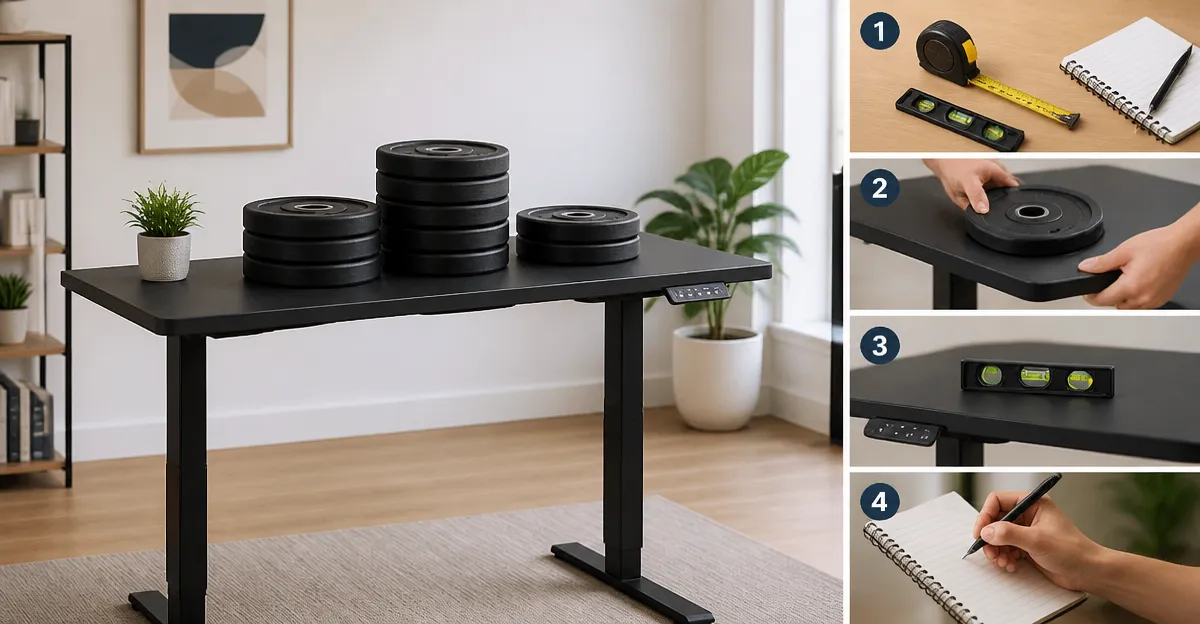
Understanding the maximum load a standing desk can sustain is essential for preventing structural failure and protecting valuable equipment. This guide will teach the reader how to evaluate weight capacity using inexpensive, readily available items while maintaining a safe environment. One will learn to assemble test equipment, apply incremental loads, observe deformation, and record findings for future reference. By following these procedures, the reader can ensure long‑term stability and avoid costly repairs.
What You’ll Need
- Digital kitchen scale or portable luggage scale (minimum 50 lb capacity)
- Set of calibrated sandbags or water‑filled containers (each 5 lb–20 lb)
- Measuring tape or ruler
- Non‑slip mat or rubber pads
- Notebook and pen for data logging
- FITUEYES Sit‑Stand Converter Desk (optional but highly useful for stable weight placement)
Step 1: Prepare the Desk and Workspace
Begin by clearing the standing desk of all accessories, cables, and paperwork to create an unobstructed testing surface. Place a non‑slip mat on the floor beneath the desk legs to prevent sliding during load application. Verify that the desk is level by measuring the distance from the floor to the tabletop at each corner with a ruler; adjust the height mechanism until the readings are within one millimeter of each other. If the desk includes a height‑adjustable converter such as the FITUEYES Sit‑Stand Converter Desk, lock it in its lowest position to provide a solid base for subsequent weight placement.
Step 2: Gather and Verify Test Weights
Select sandbags or water containers that are clearly labeled with their individual mass; this ensures repeatable increments and eliminates guesswork. Use the digital scale to confirm each bag’s weight, recording the exact value in the notebook for accuracy. The FITUEYES Sit‑Stand Converter Desk can serve as a secondary platform to hold the bags while you verify their mass, because its sturdy base supports up to 33 lb and its dual‑gas‑spring mechanism allows smooth height adjustments for ergonomic weighing. This dual‑purpose use reduces the need for additional furniture and keeps the testing area organized.
Step 3: Position the Desk for Load Application
Center the desk against a wall or sturdy desk frame to limit lateral movement during the test. Attach the non‑slip pads to each leg if the floor surface is smooth, thereby increasing friction and stability. Measure the distance from the wall to the front edge of the tabletop; note this measurement as it will be useful when documenting any forward tilt that may occur under load. If you are using the FITUEYES Sit‑Stand Converter Desk as a weight holder, place it on top of the desk in the central region to distribute forces evenly.
Step 4: Apply Incremental Load
Start by placing the smallest sandbag (approximately 5 lb) on the central surface of the desk, ensuring it is positioned directly over the strongest support area. Record any audible creaks, visual flex, or changes in height measured with the ruler. Increase the load by adding additional bags in 5 lb increments, pausing after each addition to observe the desk’s response. Continue this process until the cumulative weight approaches the manufacturer’s stated maximum or until you notice significant deformation, such as a sag greater than 5 mm. The FITUEYES Sit‑Stand Converter Desk is particularly helpful at this stage because its dual‑gas‑spring force allows you to lock the height after each increment, preventing accidental height changes that could skew results.
Step 5: Observe, Record, and Evaluate Results
After the final load is applied, measure the tabletop’s deflection at the center and at each corner, noting any asymmetry that may indicate uneven load distribution. Compare the observed maximum safe load with the desk’s advertised capacity; if the desk shows excessive flex before reaching the advertised limit, consider reinforcing the structure or reducing the everyday load. Document the entire process in the notebook, including timestamps, weight values, and visual observations, to create a reference for future adjustments. Finally, remove the test weights slowly, allowing the desk to return to its original height without abrupt movements that could cause wear.
Tips & Pro Tips
- Perform the test on a level surface; an uneven floor can create false readings and increase the risk of tipping.
- Use a friend to assist with placing heavy bags; this reduces the chance of dropping equipment and ensures controlled loading.
- If the desk includes cable management trays, remove them before testing to eliminate additional weight that could affect results.
- For a more precise measurement of deflection, place a small ruler vertically against the tabletop edge and record the gap before and after loading.
- Consider repeating the test after a few weeks of regular use, as material fatigue may alter capacity over time.
Troubleshooting
Problem: The desk wobbles or tips during load application.
Solution: Re‑evaluate the placement of non‑slip pads, ensure the floor is flat, and verify that the desk legs are fully extended and locked.
Problem: The height adjustment mechanism slips while adding weight.
Solution: Engage the simple‑touch height‑locking mechanism on the FITUEYES Sit‑Stand Converter Desk and double‑check that the gas springs are fully engaged.
Conclusion
Testing a standing desk’s weight capacity at home empowers the user to maintain a safe and ergonomic workspace. By following the systematic steps outlined above, the reader can accurately determine the maximum load the desk can sustain without compromising structural integrity. The inclusion of reliable tools such as a digital scale, calibrated sandbags, and the optional FITUEYES Sit‑Stand Converter Desk enhances precision and convenience. Armed with these insights, one can confidently arrange equipment, avoid overloading, and extend the lifespan of the standing desk.
Products Mentioned in This Guide
Frequently Asked Questions
How can I safely test my standing desk's weight capacity at home?
Use a digital scale and calibrated sandbags or water containers, placing them incrementally on the desk while monitoring for deformation.
What tools are essential for a DIY weight capacity test?
A digital kitchen or luggage scale (≥50 lb), sandbags or water‑filled containers, a measuring tape, non‑slip mat, and a notebook for logging results.
How many pounds should I add per test increment?
Add 5–10 lb increments to observe subtle changes without overloading the desk abruptly.
What signs indicate my standing desk is reaching its limit?
Noticeable sagging, wobbling, or audible creaking of the frame suggest the desk is nearing its maximum load.
Should I record the test results, and why?
Yes, logging each weight and any deformation helps track the desk’s performance and informs future equipment placement.